Obrázek

No.
PPE, washing agents, cleaning agents, disinfectants, and protective beverages must be provided by the employer free of charge based on the employer’s own list, prepared based on risk assessments and specific working conditions The employer cannot substitute the provision of PPE with financial compensation (i.e., the employer cannot give you money to purchase PPE on your own).
No, unless the returned PPE was excessively damaged (beyond what is reasonable given its period of use).
According to the Labor Code, PPE, washing agents, cleaning agents, disinfectants, and protective beverages must be provided free of charge to employees based on the employer’s own list, prepared based on risk assessments and specific working conditions.
It is then the employee's obligation to return the used PPE. It is up to the employer to decide how to handle the returned PPE. If the conditions set out by Government Regulation No. 390/2021 Coll. are met (the employer must ensure hygiene when reassigning PPE to another employee) and the PPE has not expired, it can be reused for other employees.
Yes.
Upon termination of employment or termination of an agreement on work performed outside the employment relationship, the employee is obliged to return the used PPE. Your employer may ask you for financial compensation if you do not return the PPE or if it is excessively damaged (beyond what is reasonable given its period of use). You can agree with the employer to purchase the PPE at its remaining value.
No.
If you have taken up a position for which PPE is required, your employer must provide you with this PPE immediately after starting work or before starting any work where PPE is needed. It is not possible to provide PPE only after the probationary period.
The employer is obliged to provide employees with protective beverages in workplaces with unsatisfactory microclimatic conditions, to the extent and under the conditions specified by the implementing legislation.
Protective beverages are provided to protect health from the effects of heat or cold stress. Such beverages must be safe for consumption, contain no more than 6.5% sugar by weight, they may, however, include substances that enhance the body’s resilience. Alcohol content must not exceed 1% by weight. Protective beverages for young employees must not contain alcohol.
Protective beverages for heat stress must be provided in an amount corresponding to at least 70% of fluid and mineral loss through sweat and breathing during an eight-hour shift.
The basis for assessing the entitlement to a protective drink is to measure the temperature at the workplace and the class of work performed. Government Regulation No. 361/2007 Coll. divides employees into so-called classes according to the physical demands of the work performed. There are eight classes – Class I, IIa, IIb, IIIa, IIIb, IVa, IVb and V. The types of work performed with assignment to classes are only indicative for employers (the list is limited). Employers must classify employees into the appropriate work class. They must also inform you of the classification.
Entitlement to protective beverages arises in the following cases:
Employees performing lighter work (e.g. office, administrative work) are entitled to a protective beverage if the temperature at the workplace exceeds 34°C.
Protective beverages may include natural mineral water with low mineralization, spring water, or water meeting equivalent microbiological, physical, and chemical standards (for work classes I to IIIa) or natural medium mineralized water (for work classes IIIb to V). For light work, drinking water provided by the employer also meets these requirements.
Protective beverages for cold stress must be provided warm and in an amount of at least half a liter per eight-hour shift.
Protective beverages for cold stress are provided for work at:
Employers must provide washing, cleaning, and disinfecting agents based on the extent of contamination to the skin and clothing.
For employees exposed to substances that may cause skin irritation or contamination, employers must provide washing and cleaning agents appropriate to the substance, as well as regenerative creams and ointments if necessary.
Types of work based on contamination levels and recommended amounts of washing and cleaning agents are listed in Annex No. 4 to Government Regulation No. 390/2021 Col. If washing or cleaning agents are permanently available in workplace sanitary facilities, Annex No. 4 does not apply to these agents; this exception does not include textile towels provided to employees performing very dirty or dirty work.
PPE for head protection
Helmet
PPE for hearing protection
Earplugs

Earmuffs
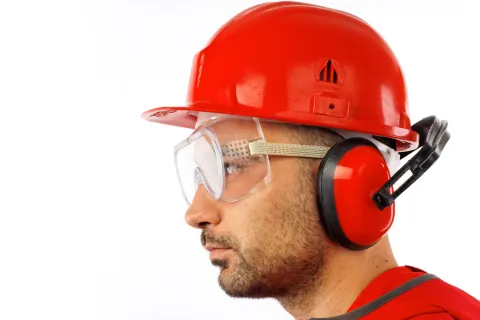
PPE for eye and face protection
Face shield
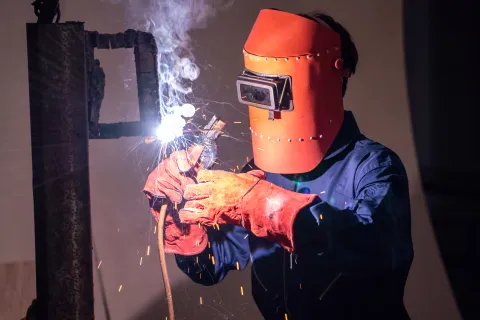
PPE for respiratory protection
Filtering half mask
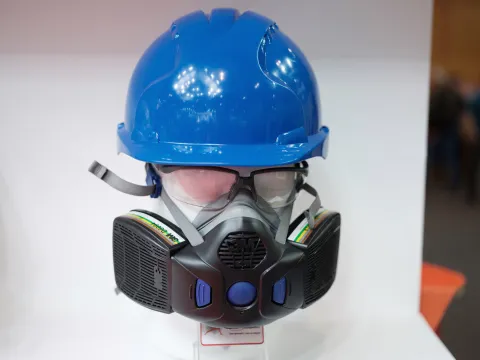
Respirator with a valve
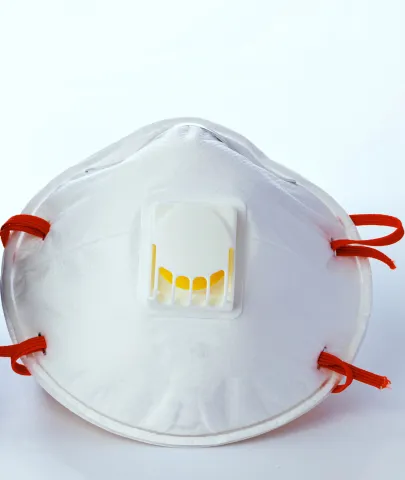
PPE for hand protection
Protective gloves

PPE for protection against falls from height

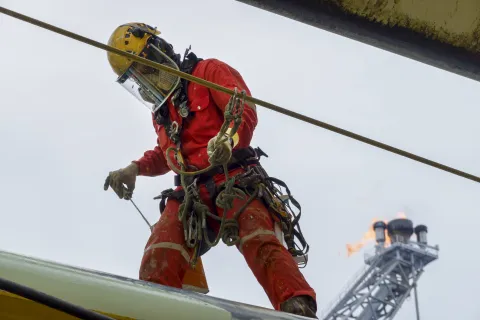

The source of photos: Depositphotos.com
Other films featuring the character Napo are available at https://www.napofilm.net/en/napos-films/films?films=all.
The Napo Consortium currently has eight members
– AUVA (Austria), CIOP (Poland), DGUV (Germany), EU-OSHA (Bilbao, Spain), INAIL (Italy), INRS (France), SUVA (Switzerland) and TNO(The Netherlands).





The employer is obliged to provide employees with personal protective equipment (PPE) if risks cannot be eliminated or sufficiently reduced by collective protection measures (e.g., installation of railings, exhaust ventilation, etc.) or by work organization measures (e.g., employee rotation, adjustment of work schedules, etc.).
Personal protective equipment (PPE) is protective equipment that must protect workers from risks, must not endanger their health, must not interfere with their work, and must comply with the requirements set out by a directly applicable European Union regulation (Regulation (EU) 2016/425 of the European Parliament and of the Council). PPE should always bear the CE marking.
Yes.
It is a legal obligation set out in the Labor Code. Employees are required to use PPE and protective devices (such as covers) at work and must not modify or deactivate them without authorization. The employee must be demonstrably familiar with the use of PPE (e.g. through training, which they sign off on). The employer is obliged to keep the PPE in usable condition and to monitor its use.
Section 106 (4) (d) of Act No. 262/2006 Coll., the Labor Code
First and foremost, you are endangering your own safety and health. The employee is obliged to use PPE and the employer is obliged to monitor its use. Your employer is therefore also liable to a fine from labor inspection authorities. By not using the assigned PPE, you are in breach of the employee's obligations under the Labor Code, which may ultimately lead to termination by the employer.
Section 106 (4) (d) of Act No. 262/2006 Coll., the Labor Code
No.
PPE is assigned by the employer based on their own list, prepared based on a risk assessment and the specific working conditions. The employer determines the method, conditions, and duration of PPE use according to the frequency and severity of risks, the nature and type of work, and the workplace, taking into account the properties of the PPE.
The use of PPE is regulated by Government Regulation No. 390/2021 Coll., its annexes, which together serve as "instructions" for the use of PPE, are of great importance:
In an environment in which clothing or footwear is subject to extraordinary wear or contamination at work or serve a protective function, the employee is also entitled to receive work clothes or footwear from the employer, since they are considered PPE.
PPE must:
Where it is necessary to use more than one PPE during work, they must be compatible with each other.
PPE must be manufactured in such a way that, at the same time as providing protection for workers, it does not restrict workers from carrying out the activity in which they are exposed to risk. The materials used in PPE must not adversely affect health or safety (e.g., by causing allergic reactions), must not cause excessive irritation, or result in injuries. On the contrary, they must be as light as possible and minimize restrictions to the face, eyes, field of vision, and respiratory system. If necessary, they must also be equipped with anti-fogging features.
If the assigned PPE is unsuitable for you for various reasons, contact your employer, or alternatively, a professionally competent person responsible for risk prevention tasks (commonly referred to as "bezpečák" (safety officer) in practice), the occupational health services provider, the labor union, or the employee representative for OSH to find an appropriate solution.